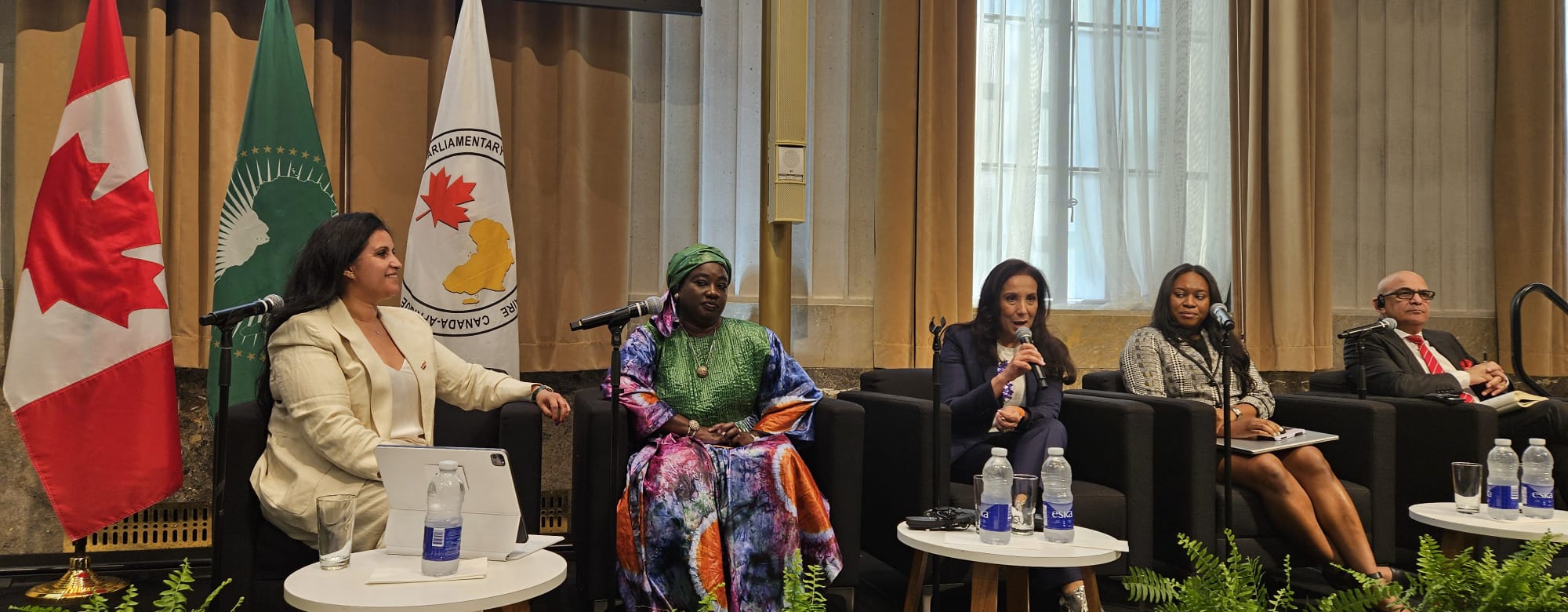
Brain Drain and Wealth Creation: Africa Takes Center Stage in the Global Debate at the Parliament of Canada
On May 28, 2025, as part of Africa Day in Canada, the Parliament of Ottawa hosted a high-level roundtable on a topic as complex as it is crucial: the relationship between brain drain and wealth creation in Africa. Moderated by Fatiha Charradi, Director of UM6P Global Hubs Canada, the session—organized under the auspices of the Canada–Africa Parliamentary Association (CAAF)—brought together diplomats, parliamentarians, researchers, and development practitioners for a candid and insightful exchange.
During the discussion, panelists explored the mechanisms, data, and underlying dynamics driving the exodus of African talent — researchers, engineers, doctors, and entrepreneurs — attracted by more stable and better-remunerated professional environments abroad. The findings were striking: over 4.8 million educated Africans currently live overseas, and nearly 20,000 highly skilled professionals leave the continent each year.
While this represents a significant loss for many countries, it also opens the door to a strategic rethinking around “brain circulation” — a model of circular mobility with high potential for human and economic return on investment. The panel highlighted the tremendous contributions of African diasporas, not only through financial remittances — which account for up to 3% of GDP in some countries — but also via the exchange of ideas, skills, and networks. The key challenge, then, is how to turn an outflow into an anchor point: how to establish truly bidirectional mobility that enables temporary returns, co-development projects, technology transfer, and the rise of innovation clusters bringing together local and global talent.
In this context, UM6P Global Hubs Canada was presented as a living model of transcontinental synergy. Its mission: to catalyze connections between Africa, Canada, and the international ecosystem—particularly by engaging African talent based in North America. This approach reflects a new vision for African development: one not defined by rupture, but by constant interaction with diasporas, global research centers, and institutional partners in the Global North. At the heart of this parliamentary discussion emerged a powerful message: Africa does not lack talent—it lacks the conditions for that talent to thrive locally.
Addressing this challenge requires joint mobilization: more flexible migration policies from host countries, stronger retention and attractiveness mechanisms in countries of origin, and concrete commitments from the diasporas themselves to become active agents of change.